
What Is the Best External Consumer Unit in 2026?
Choosing the best External Consumer Unit in 2026 is not just a question of price or appearance. It means matching protection, enclosure, and available circuit capacity to the property and its outdoor conditions. A unit mounted beside a damp garden wall faces different demands from one installed in a sheltered garage. Details matter.
Electrical educator John Ward is a useful reference for readers assessing installation quality. To avoid presenting an unverified quotation as his exact words, this guide uses an editorial paraphrase of a sound safety principle: “Choose protection for the real conditions, then have the installation checked by a qualified professional.” It is a practical standard, not a product endorsement. A tidy-looking enclosure alone proves little.
The sections ahead compare weather resistance, protective devices, space for future circuits, build quality, and value. They also explain why an IP rating needs context: the rating, mounting position, cable entries, and exposure all affect suitability. Small errors matter. A cramped enclosure can make later changes awkward, while a poorly chosen location may expose equipment to rain or impact. Product specifications help, but they cannot replace an assessment of the actual installation. This guide will identify strong options and their trade-offs, while acknowledging that the “best” External Consumer Unit depends on the site. That answer is less neat than a simple winner. It is also more reliable.
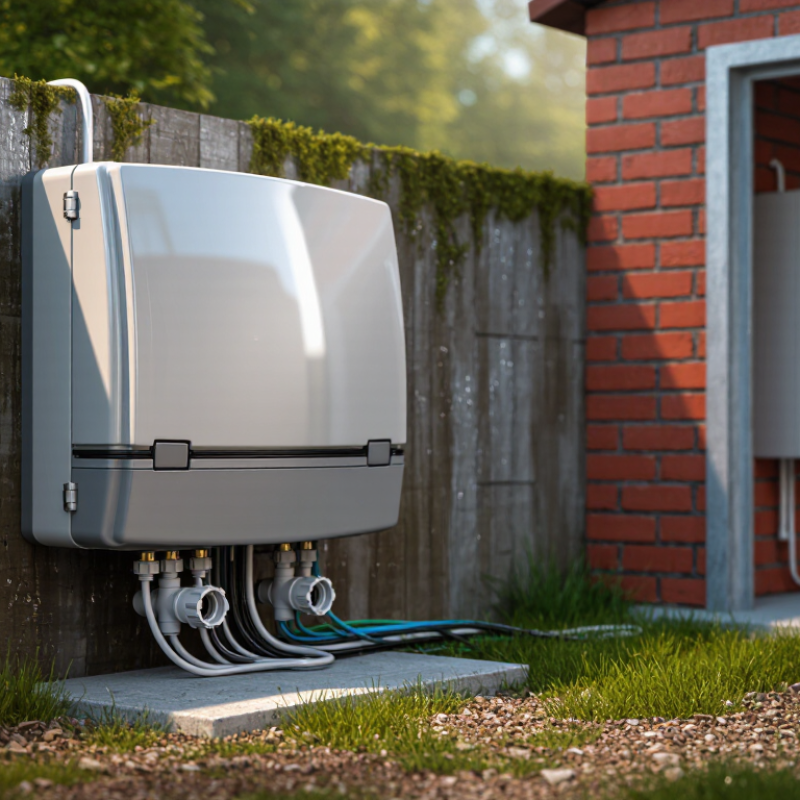
What an External Consumer Unit Is and Where It Is Used
An external consumer unit is a weather-resistant electrical distribution board fitted outside a building. It receives power from the main installation and divides it into protected circuits. Inside, circuit breakers and residual-current protection help reduce risks from overloads, electrical faults, and leakage. It is a control point, not a simple outdoor socket. Details matter.
You may find one on a house wall beside a garage, workshop, garden room, or outbuilding. It can supply lighting, sockets, pumps, gates, or other dedicated outdoor equipment. For example, a separate circuit can keep shed lighting available if a garden tool trips another circuit. That convenience depends on correct circuit design, cable sizing, earthing, and protective-device coordination. Outdoor locations are harsh. Rain is only part of it. Wind-driven water, dust, condensation, sunlight, and temperature changes can all affect the enclosure and its components.
The unit’s ingress-protection rating should suit its actual exposure; a high rating does not make it safe underwater. Mounting height and cable entries also matter, especially where water may run down a wall. A common mistake is choosing by appearance or price alone. Have a qualified electrician assess the supply capacity, earthing, and local installation requirements before fitting or changing one. The exact setup varies. Even a tidy box can conceal poor connections.
| Topic | What It Means | Where or When It Is Used | What to Check |
|---|---|---|---|
| External consumer unit | A distribution board designed for installation outdoors or in another exposed location. It contains protective devices that distribute electricity to circuits and help protect against faults. | Examples include an outbuilding, garage, garden workshop, or an outdoor supply point. | Confirm that the unit is intended for the installation environment and is suitable for the electrical system and circuit requirements. |
| Weather-resistant enclosure | The enclosure helps protect electrical components from dust, moisture, and physical contact. Its level of protection is indicated by an IP rating. | Useful where rain, splashing water, dust, or outdoor conditions may affect the installation. | Choose an appropriate IP rating for the actual exposure. An IP rating does not make an enclosure suitable for every location or installation method. |
| IP rating | The first digit describes protection against solid objects and dust; the second describes protection against water. For example, IP65 is dust-tight and protected against water jets under specified test conditions. | Use the rating as one factor when comparing units for a sheltered or exposed position. | Check the manufacturer’s documentation and consider cable entries, glands, covers, seals, and the installed orientation. |
| RCD protection | A residual current device (RCD) detects certain imbalances between live and neutral currents and disconnects the supply when its operating conditions are met. | May be used to provide additional protection for circuits, depending on the circuit design and applicable wiring rules. | Protection requirements depend on the installation. An RCD does not replace overcurrent protection or correct wiring and earthing. |
| RCBO protection | An RCBO combines residual-current protection with overcurrent protection for an individual circuit. | Often considered where circuit-by-circuit protection and fault isolation are desirable. | Check compatibility with the consumer unit, the required ratings, and the circuit design. |
| Surge protection | A surge protective device (SPD) limits transient overvoltages and can reduce the risk of damage to connected equipment. | May be relevant where the installation or connected equipment requires surge protection under the applicable design rules. | Selection and installation depend on the supply arrangement, risk assessment, and local requirements. |
| Enclosure material | Outdoor enclosures are commonly made from insulating plastics or corrosion-resistant metals. Materials differ in impact resistance, weight, and resistance to corrosion or sunlight. | Material choice can matter in exposed, damp, coastal, or impact-prone locations. | Check the stated environmental and mechanical ratings rather than choosing by material alone. |
| Capacity and spare ways | The number of usable circuit positions determines how many protective devices the unit can accommodate. | Relevant when supplying several circuits or allowing for planned future additions. | Allow space for the required devices and confirm that the enclosure and busbar arrangement are compatible. |
| Installation position | Even a weather-resistant unit needs a suitable mounting position and correctly installed cable entries. | Consider access for operation and inspection, exposure to direct weather, and the route of incoming and outgoing cables. | Follow the unit’s installation instructions and applicable electrical regulations; avoid relying on the enclosure rating alone. |
| Choosing the “best” unit | There is no single best external consumer unit for every property. Suitability depends on the location, circuits, protective devices, supply characteristics, and environmental exposure. | Compare units against the specific needs of the installation rather than using a brand or enclosure rating as the only criterion. | Have selection, installation, and testing carried out by a qualified electrician in accordance with applicable local rules. |